

\
Key Takeaway
- Double eyelid surgery using laser or suture techniques is minimally invasive, with less swelling and quick recovery. It suits thin eyelids with little fat, but results may not be permanent, especially in thicker eyelids.
- Incisional double eyelid surgery removes excess fat and skin to create a clear, long-lasting crease. It is ideal for thick or drooping eyelids but requires more recovery time than minimally invasive techniques.
- Double eyelid surgery can be combined with other procedures such as excess skin removal, fat grafting, ptosis correction, or a sub-brow lift to achieve more balanced and natural-looking results.
Let’s explore the different double eyelid surgery techniques, along with the pros and cons of each method. This overview will help you understand the differences between each approach and choose the option that best suits your eye shape, lifestyle, and personal needs with greater confidence.
1. Double Eyelid Creation with New Lovely Microlaser
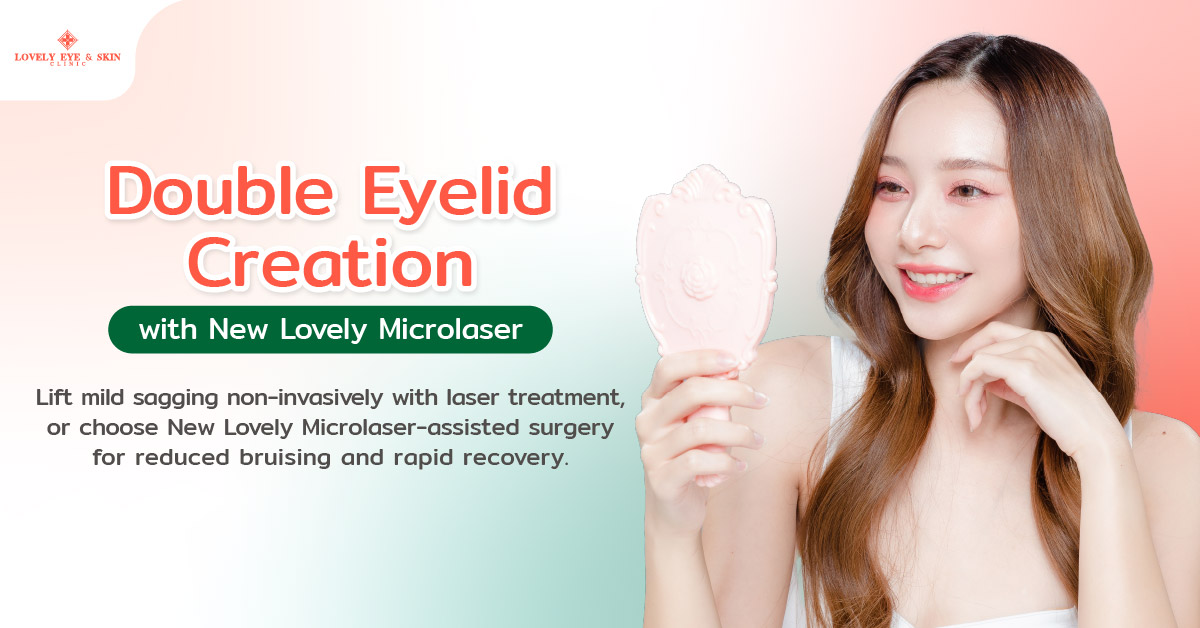
Laser treatment is a non-surgical method used to tighten and lift mildly drooping eyelids. This approach is suitable for individuals who already have double eyelids but experience slight sagging and prefer a non-invasive option. In addition, the New Lovely Microlaser–assisted technique uses laser technology to support surgical procedures, helping to reduce bleeding, swelling, and bruising while promoting faster wound healing.
However, for individuals with monolids who wish to create a well-defined double eyelid, surgical procedures—especially those assisted by Microlaser generally provide more effective and aesthetically pleasing results than laser treatment alone.
Advantages
- No visible scarring: The incision points are very small, and once fully healed, scars are minimal and typically not visible.
- Less swelling: This technique generally results in less swelling compared to traditional methods; however, when performed by a highly skilled surgeon, the difference in swelling may be minimal compared to the minimal incision technique.
2. Double Eyelid Surgery by Three-Point Suture Technique
The three-point suture technique creates a double eyelid crease by placing sutures at three points to connect the eyelid skin to the underlying muscle. Because this method does not involve skin or fat removal, the crease relies mainly on the sutures for support. Over time, the sutures may loosen or the surrounding tissue may relax, especially in patients with thick eyelids, excess fat, or frequent eyelid movement. As a result, the double eyelid crease may become shallower or disappear, making this technique less durable compared to incision-based methods.
Advantages
- No visible scars: Since no skin incision is made, there are no noticeable scars after healing.
- Minimal swelling and bruising: Most patients experience only mild swelling or bruising, which usually subsides quickly.
- Short procedure time: The procedure is relatively quick and can be completed within a short time.
- Faster recovery: Patients can return to daily activities sooner compared to incision techniques.
- Natural-looking double eyelid crease: The crease appears soft and natural, especially in patients with suitable eyelid anatomy.
- Non-surgical approach Ideal: for patients who prefer a less invasive option without cutting the skin.
Disadvantages
- The crease may not be permanent: Over time, the sutures can loosen, causing the crease to fade or disappear.
- Limited crease design: The height and shape of the crease are limited, especially in patients with thick upper eyelids.
- Less suitable for thick or fatty eyelids: In patients with thick skin or excess fat, the crease may look puffy or less defined.
- Limited fat and skin removal: This technique does not allow for the removal of excess skin or fat.
- Not ideal for severe eyelid drooping (ptosis): In cases of significant ptosis, the eyelid may droop again after swelling subsides.

3. Double Eyelid Surgery by Small-Incision Technique (Lovely No Stitch)
This technique is performed through a small incision of approximately 3-5 mm on the upper eyelid, depending on the surgeon’s technique. The incision allows the surgeon to create a more defined eyelid crease and, if necessary, remove a small amount of fat to improve the overall contour of the eyelid.
Advantages
- Minimal scarring: The scar is very small and usually fades easily over time.
- Short procedure and quick recovery: The operation takes less time, with less swelling and faster healing compared to the full-incision technique.
- Suitable for younger patients: Ideal for individuals with minimal excess skin or a relatively thin upper eyelid.
- More effective than the suture technique: This method can create a well-defined double eyelid and allows for more fat removal compared to the suture technique.
Disadvantages
- Not suitable for severe ptosis: In patients with severe eyelid drooping, once the swelling subsides, the eyelids may droop again. The crease may appear smaller, or mild outer eyelid hooding can occur.
- Thick eyelids may look puffy: In patients with very thick upper eyelids, the crease may look puffy because the crease is created by suturing, without removing excess skin or tissue.

4. Double Eyelid Surgery by full-incision technique (Lovely Blepharoplasty Signature)
Full-Incision Double Eyelid Surgery is a technique that creates a well-defined eyelid crease through a long incision, while simultaneously removing excess skin and fat from the upper eyelid. The crease is carefully designed to suit each individual’s eye shape and facial features, using the patient’s natural tissue and precise suturing for long-lasting, natural looking results. This technique can also help lift the outer corners of the eyes, correct drooping outer eyelids, and effectively reduce eyelash irritation caused by excess skin.
This method is suitable for individuals with single eyelids, small or hidden eyelid creases due to eyelid drooping, as well as those with thick or sagging eyelids caused by excess skin and fat.
Advantages
- Reduces the risk of lateral hooding: This technique minimises the possibility of lateral hooding more effectively than the minimal-incision technique, except in cases of severe blepharoptosis.
- Allows greater fat removal: It enables more effective removal of excess fat, making it especially suitable for patients with thick or fatty upper eyelids.
Disadvantages
- More swelling and a longer incision: This technique involves more swelling and a longer incision compared to the minimal-incision technique, resulting in a longer recovery time.
- Similar disadvantages to the small-incision technique: Some limitations are similar to those of the small-incision technique, depending on individual eyelid conditions.
5. Double Eyelid Surgery with Inner Corner Eye Extension, Fat Graft, Ptosis Surgery
The doctor will assess each patient individually to determine whether medial epicanthoplasty is necessary, as not everyone who desires double eyelid surgery requires this procedure. The decision is based on eye structure, facial proportions, and the desired surgical outcome.
Advantages
- Makes the eyes look bigger and brighter: By reducing the inner eye fold, the eyes appear wider and more open.
- Improves the symmetry of the eyes: Helps balance the inner eye corners for a more harmonious look.
- Enhances the double eyelid result: Allows the double eyelid crease to be seen more clearly, especially at the inner corner.
- Creates a more open and youthful appearance: Reduces a closed or crowded look around the inner eye area.
- Customizable to each patient: The degree of correction is tailored to suit individual eye structure and facial features.
Disadvantages
- Additional scarring at the inner eye corner: A small scar may occur at the inner corner of the eye, although it usually fades over time.
- More swelling during recovery: Swelling may be slightly greater compared to double eyelid surgery alone.
- Longer recovery time: Healing may take longer when combined with other eyelid procedures.
- Risk of overcorrection: If too much skin is removed, the inner corner may appear too open or unnatural.
6. Double Eyelid Surgery with Sub Brow Lift
This technique combines double eyelid surgery with a sub-brow lift, which involves removing excess skin just beneath the eyebrow. By lifting the area under the brow, the procedure reduces eyelid drooping and heaviness while creating or enhancing the double eyelid crease.
This approach helps open up the eyes without making the crease too high, resulting in a more natural and refreshed appearance. It is especially suitable for patients with sagging upper eyelids or age-related eyelid drooping who want clearer eyes while preserving a natural eyelid shape.
Advantages
- Reduces eyelid drooping effectively: Lifting the skin beneath the eyebrow helps correct sagging and heaviness of the upper eyelids.
- Creates a natural-looking double eyelid: The crease does not need to be set too high, resulting in a soft and natural appearance.
- Preserves the natural eyelid shape: Improves eye openness without dramatically changing the original eye contour.
- Improves a tired or aged look: Makes the eyes appear brighter, more refreshed, and youthful.
- Suitable for age-related eyelid sagging: Ideal for patients with loose or drooping eyelids due to aging.
- Long-lasting results: Removing excess skin under the brow helps maintain the result over time.
Disadvantages
- Visible scar under the lash line: A scar may remain beneath the eyebrow, although it usually fades over time.
- More swelling and bruising: Swelling and bruising may be greater compared to double eyelid surgery alone.
- Longer recovery period: Healing may take longer, especially in the sub-brow area.
- Limited change to crease height: This technique focuses more on lifting sagging skin rather than significantly increasing crease height.
- Not suitable for everyone: May not be ideal for patients who want a dramatic change in eyelid shape.
Conclusion
Double eyelid surgery offers a variety of techniques, ranging from non-surgical methods and suture techniques to minimal-incision and full-incision surgery with excess skin removal. Each method is suitable for different eyelid structures, amounts of skin and fat, and individual aesthetic goals. Suture techniques are ideal for patients with thin eyelids and minimal fat but tend to provide less permanent results, while incision-based techniques are more effective for correcting drooping eyelids, excess fat, or ptosis. Additional procedures such as laser-assisted surgery, medial epicanthoplasty, sunken eye correction, and sub-brow lift can be used to address specific concerns.
At Lovely Eye & Skin Clinic, each patient receives a personalized evaluation, and the most appropriate technique is carefully selected to achieve natural-looking, harmonious, and long-lasting double eyelid results tailored to individual eye anatomy.
Frequency Ask Question About Double Eyelid (FAQ)
This section answers the most common questions about double eyelid surgery, helping you better understand the procedures, techniques, recovery process, and what to expect, so you can make an informed and confident decision.
What is the ideal age for double eyelid surgery?
There is no specific “perfect” age for double eyelid surgery, as suitability depends more on eyelid structure and overall health. Generally, patients should be at least 18 years old when facial growth is complete. Younger adults often have better skin elasticity and faster recovery. Older patients can also achieve good results, especially when combined with techniques that address excess skin or eyelid drooping. A consultation with a doctor is essential to determine individual suitability.
How long is the recovery period after double eyelid surgery?
Recovery time varies depending on the technique used and individual healing response. Most swelling and bruising improve within 1-2 weeks. Patients can usually return to daily activities within a few days, although strenuous activities should be avoided for a few weeks. Final results typically become visible after swelling fully subsides, which may take several months.
How long does double eyelid surgery last?
The longevity of results depends on the surgical technique and eyelid condition. Suture techniques may not be permanent, as the crease can loosen over time. Incision-based techniques generally provide long-lasting or permanent results. Aging and natural changes of the eyelids may still affect appearance over time. Proper technique selection and experienced surgical care help maintain results longer.

ข้อมูลโดยหมอรวงข้าว Lovely Eye พญ. ณัฐฐามณี สิริภคพันธ์ ว.35780
ผู้พัฒนาเทคนิคศัลยกรรมตาหมอรวงข้าว ตั้งแต่ ปี พ.ศ. 2553 ผู้ร่วมก่อตั้ง เลิฟลี่อายแอนด์สกิน คลินิก ปี พ.ศ. 2557 และดูแลมาตรฐาน Lovely Specialist ของ Lovely Eye & Skin Clinic